It was close to dawn in Dubai, at the end of an all-night session at COP28, with perhaps forty minutes left on the clock. I was sat near secretariat staff, so an NGO representative came over to me for help. She wanted to speak. She could not understand why nobody would give her a microphone.
I couldn’t muster the patience at that time of day (or was it night?) to explain how this all works. I simply told her that she would’ve had to talk to her constituency focal points days ago. She didn’t know what a constituency was, and I was too tired to explain.
In plenary, observers do not take the floor as individual organizations. Technically they can, but I’ve never seen it. They speak through constituencies, categories that organize NGOs. She had registered, travelled halfway around the world and sat up all night hoping to speak, but without knowing how the system worked. She is not alone.
Demand outstrips supply: for COP31 in Antalya in 2026, organizations nominated more than 37,000 people for about 9,500 observer places (COP31 Observer Handbook). In June 2026, governments flagged the growing number of observers and asked for views, due by 31 March 2027, on improving regional balance and diversity (FCCC/SBI/2026/L.6). When access is this scarce, the categories that organize observers matter more than ever, which raises a basic question: do they still describe the organizations that actually turn up?
What a constituency is, and why it matters
A constituency is a loose grouping of observer organizations with shared interests. There are nine: business (BINGO), environmental groups (ENGO), research and independent organizations (RINGO), local governments (LGMA), Indigenous Peoples (IPO), trade unions (TUNGO), women and gender groups (WGC), youth (YOUNGO) and farmers. Organizations choose which to join and can join more than one, but the secretariat recognizes the constituencies and works through each one’s focal point (UNFCCC).
Membership brings practical advantages at a COP:
- Space to work. Constituencies are typically given office or meeting space at the venue.
- Daily coordination. Constituency meetings run every day, with times and rooms advertised in the Daily Programme (Observer Handbook).
- A voice. When presiding officers open the floor to observers, the nine constituencies have priority, including for statements in plenary.
- Information. Focal points pass on briefings and news from the secretariat, often in advance. Members share information at constituency meetings.
The categories are historic. But do they represent the NGOs that attend now?
Two ways of sorting the same organizations
To test the fit, I coded the mission statements of the 1,762 NGOs that have attended four or more COPs, giving each one of six main codes: Environment, Economic, Education, Social, Governance or Development. My codes sort organizations by what they work on. The constituencies mostly sort them by what kind of actor they are, whether a business, a university, a city, a union, or Indigenous Peoples organization. Some are defined by subject, such as ENGOs.
I compared my codes with the constituency each organization lists on the UNFCCC’s admitted-NGO list.
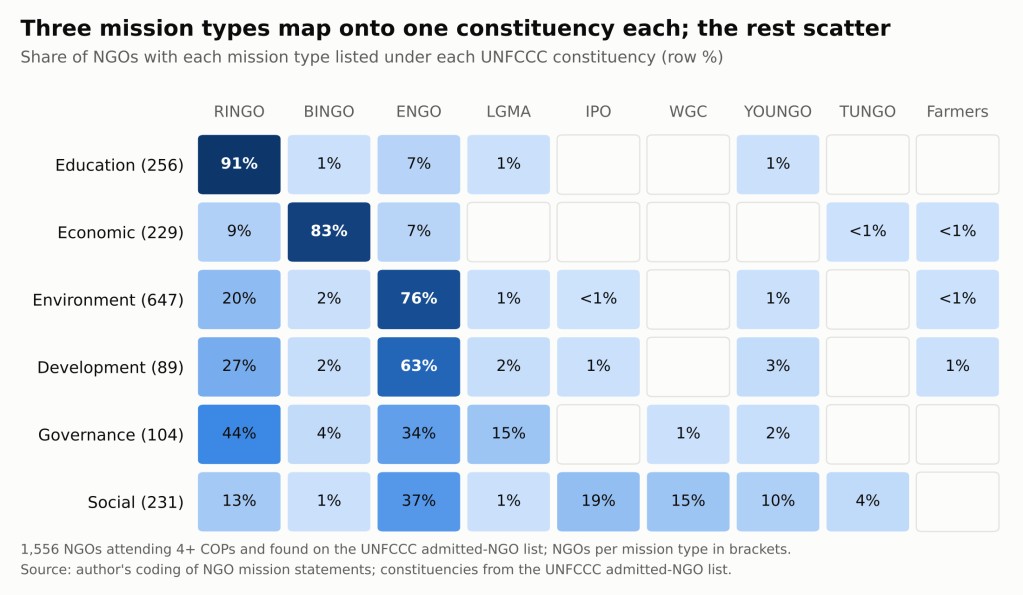
The two systems are clearly related, with a Cramér’s V of 0.55, where 0 means no association and 1 means a perfect match. But, they are far from interchangeable. If you put every organization in the most common constituency for its mission type, you would place 71% correctly, leaving nearly three in ten that the two systems sort differently.
Where the systems agree
The fit is close wherever the official category and the mission describe the same kind of organization. Nine in ten education and research organizations are RINGOs, most of them universities, and 83% of economic organizations are BINGOs.
Look beneath my broad Social code and the identity constituencies line up neatly too: 91% of Indigenous Peoples’ organizations are in IPO, 83% of unions are in TUNGO, 73% of gender organizations are in WGC and 71% of city networks are in LGMA. Here, the UNFCCC and I draw the same lines from different starting points.
Where they don’t
The mismatches are revealing, and most of them trace back to how the system was built.
ENGO, and to a lesser extent RINGO, is the default home. Three in ten ENGOs (211 of 704) are not primarily environmental organizations. They include faith groups such as the World Council of Churches, justice advocates such as Third World Network, development NGOs and youth groups. RINGO plays a similar role on a smaller scale. About half its members are not universities and they include 46 governance, 30 social-mission and 24 development organizations. An organization with no obvious home joins the broadest group it seems.
Being the default does not make ENGO an open door, however. At COP13 in Bali in 2007, before trade unions had a constituency of their own, a labour union delegate tried to attend an ENGO meeting and was told she could not, because it was open only to members of Climate Action Network (The New Climate Activism, 2021).
The environmental space is still organized largely around established networks. Climate Action Network and Demand Climate Justice dominate the resources, even though about 88% of ENGO members belong to neither (Observer Handbook). ENGO absorbs the organizations that fit nowhere else, but that does not necessarily give them a seat at its table.
The reason is history. The constituencies mirror the nine Major Groups set out in Agenda 21 at the 1992 Rio Earth Summit (UNFCCC): women, children and youth, Indigenous Peoples, NGOs, local authorities, workers and trade unions, business and industry, the scientific and technological community, and farmers. In that scheme, “NGOs” was the bucket for everyone not defined by identity or sector, and in the climate regime it became the environmental constituency. Development was treated in 1992 as a separate governance area with its own agenda, so it never got a group, and the climate regime has never added one, even though finance and development now sit at the heart of the talks.
Environmental think tanks count as researchers. One in five environmental organizations (128) sits in RINGO, including the World Resources Institute and the Stockholm Environment Institute. The constituencies separate research from advocacy, whereas a mission-based view puts these organizations in the same community as the ENGOs they often work alongside.
Development and governance have no home. Development organizations split between ENGO (63%) and RINGO (27%). Governance organizations, from parliamentary networks such as GLOBE to policy institutes, split three ways between RINGO (44%), ENGO (34%) and LGMA (15%). That is nearly 200 frequent attendees with no constituency of their own. The secretariat lists informal groups for parliamentarians and for faith-based organizations, but informal groups do not have constituency status (Observer Handbook).
Development NGOs are perhaps the most obvious group that needs their own constituency. They work with people most vulnerable to climate change. Decades of climate progress risk being swept (or burnt) away. Their views are missing in the formal architecture of the UNFCCC.
Youth and farmers are only loosely captured. Of 37 youth-led organizations, 16 sit outside YOUNGO, mostly in ENGO, and only 3 of 41 agriculture-focused organizations are in the Farmers constituency. Imagine a youth delegate whose organization works on forests. Should she go to the YOUNGO coordination meeting or the ENGO one? Her organization could join both, but she can only be in one room at a time, and each meeting will be setting priorities she cares about.
What this means for observer participation
Constituency figures are the usual shorthand for who participates at the COPs, and they should be read with care. The identity constituencies track real communities well, but ENGO and RINGO are partly residual categories, and development, governance and faith-based organizations have no constituency at all.
This is a question of effective participation, not just classification. Think back to the representative in Dubai. Speaking slots, briefings, workspace and workshop places all flow through constituencies, so an organization in an ill-fitting one competes for them on someone else’s terms, and the views of development organizations in particular may reach Parties only faintly, if at all. As badges become scarcer, constituencies are likely to matter more, not less. As governments review how observers take part, they should ask not only who gets a badge, but whether the categories that organize observers still fit who those observers are.
One caveat applies. The UNFCCC list shows a single current affiliation for each organization, although organizations can join several constituencies and may have switched over the years, and 206 frequent attendees (about 12%) were not on the list at all.


Leave a Reply