Brief outlines of big concepts in the COP reform debate.
What is COP?
COP stands for Conference of the Parties, the annual summit where nearly 200 countries meet to negotiate global climate action. The first COP was held in 1995; COP30 took place in Belém, Brazil, in November 2025.
But that’s just the legal bit. COP has become a stand-in term for the enormous amount of activity that takes place at these meetings. There are the negotiations among countries, exhibitions and events by civil society, and pavilions hosted by countries and other organizations.
My first COP was in 2012 (Doha). I remember regretting wearing heels. At the time, delegates commented on the new, huge venue. By today’s standards, Doha was a small COP in terms of participation and venue size.
What is a “MegaCOP”?
Recent COPs have grown far beyond their original scale, drawing tens of thousands of delegates, observers, and high-level attendees (sometimes called “VVIPs”) rather than a few thousand negotiators. “MegaCOP” captures this growth, not only in the number of people, but in all the types of work happening at a COP.
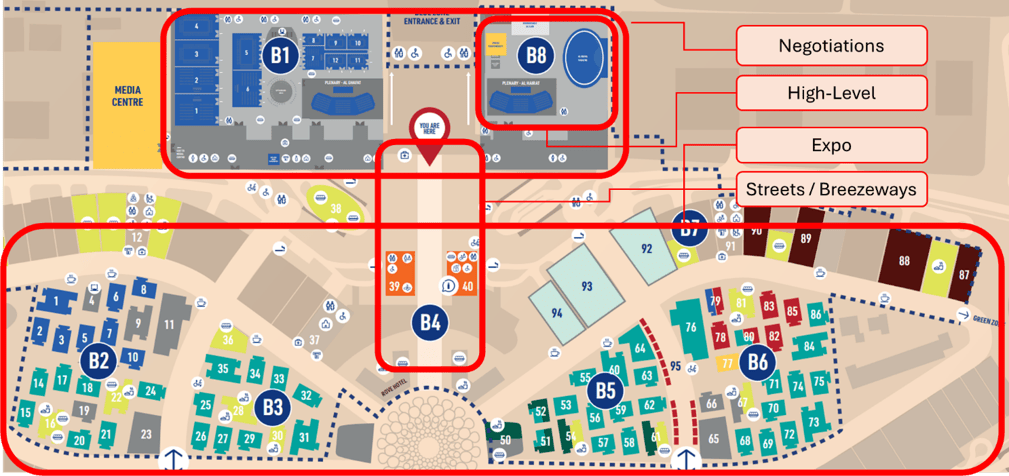
To me, there are four distinct sites at a MegaCOP.
- Negotiations: the formal talks among negotiators to address issues on the agendas
- High-level events: a summit of speeches (and sometimes declarations) delivered by world leaders, and also other events hosted by the COP President on specific issues that include leaders from countries, businesses, civil society.
- Expo: side events, pavilions, exhibitions, the Global Climate Action Hub. A space mostly for observers and (non-negotiating) country representatives to share information and showcase their efforts.
- Streets or Breezeways: the area for protest or demonstrations. In some countries, protests can also happen on the streets. When onsite, demonstrations are registered and monitored by security.
Below, I superimposed these four sites onto the COP28 (Dubai) venue. It’s typical of a MegaCOP — a huge area for the expo, and about a dozen rooms for negotiations. It would take at least 10-15 minutes to walk from the expo to the negotiations (in the heat).
Who’s who: Parties, Observers, and the Secretariat
Parties are the national governments that negotiate and vote. Observers are everyone else with accreditation, including UN agencies, intergovernmental organizations, NGOs, business groups, and academics, who can attend and lobby delegates but cannot vote. The UNFCCC Secretariat, based in Bonn, organizes the conference and keeps the official record.
Who’s who: the negotiating blocs
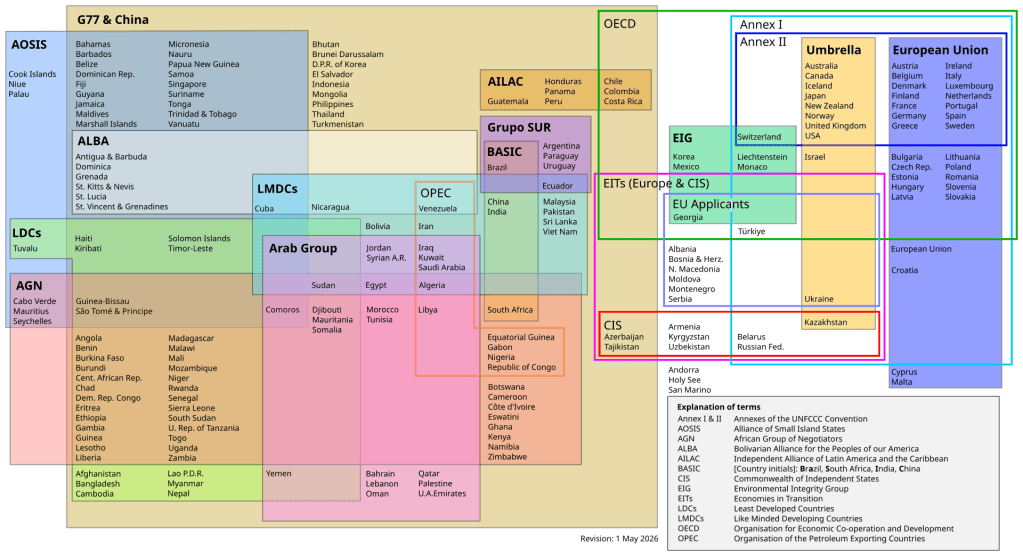
Countries typically negotiate as part of blocs rather than individually. The most prominent include the G77 and China, the largest bloc, representing developing countries; the Alliance of Small Island States (AOSIS), representing small island and low-lying states most exposed to climate impacts; the Umbrella Group, a coalition of mostly developed non-EU countries including the US, Japan, and Australia; and the EU, which negotiates as a single bloc.
These groups overlap, as Jonas Haller has worked to visualize. Not all of the groups in the diagram speak actively in the negotiations. Most will give an opening statement. But in my experience in the negotiating rooms, the main players are AOSIS, LDCs, LMDCs, AILAC, EIG, EU, AGN, and the Arab Group. It’s an alphabet soup, yes. Add in the G-77/China, which groups nearly all developing countries. But that diversity brings complexity – the Group speaks with one voice on very few issues (agriculture, finance), and shares very general views on some other issues. Often in the contact groups, the smaller coalitions stand alone.
Observers
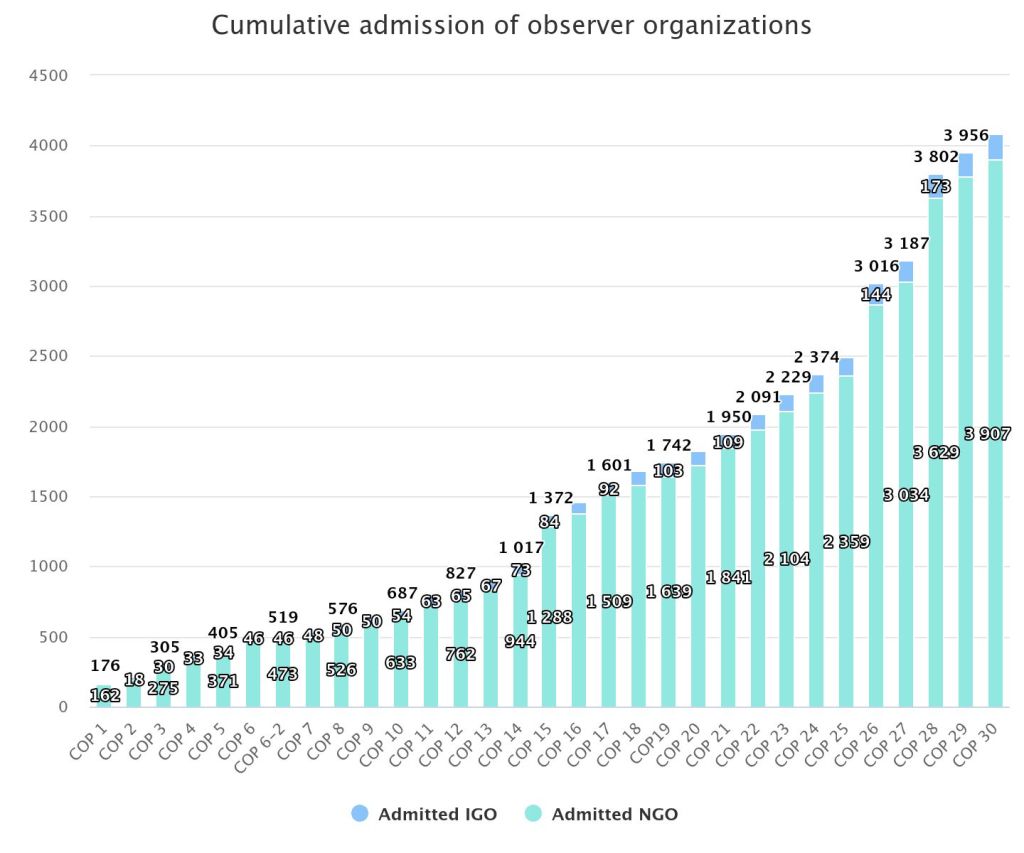
Observer organizations are grouped into nine constituencies (ENGO, BINGO, IPO for Indigenous Peoples, YOUNGO, RINGO for research institutions, TUNGO for trade unions, LGMA for local governments, Farmers, and Women and Gender). Each has its own focal points who coordinate access to badges, messaging, and speaking slots.
The badge system matters more than it sounds: observer badges are finite, allocated through host-country and constituency quotas. Demand exceeds supply. The resulting scarcity becomes a site of contention, since it determines who is physically in the room when informal deals get made, or who gets to share their views in events in the expo.
Source: UNFCCC
What is the Blue Zone?
The Blue Zone is the official term for the secured, UN-run area where negotiations, side events, and country pavilions take place, accessible only with a UNFCCC-issued badge. It is distinct from the Green Zone, a separate, more public-facing space for civil society and public programming that most host countries run alongside the official talks.
How is the COP host and presidency chosen?
The host country rotates among the UN’s five regional groups. Each group chooses which country will host. Selection sometimes becomes contentious within a regional group when several countries want to host, or if there are internal tensions. In 2023, there were worries that the Central and Eastern European region would not be able to agree: Russia blocked European countries, Armenia and Azerbaijan were engaged in military conflict, few other countries were big enough. A last minute deal (that likely include prisoner exchanges) led to Azerbaijan’s selection.
The COP President is seen as as servant of the parties. The role is to uphold the UNFCCC’s procedures and facilitate transparent negotiations. But there is also a softer agenda-setting role. High-level events are organized by the host country, to position it at the centre of global diplomacy. Political declarations are on specific issues, selected by the Presidency.
The size of MegaCOPs and the growing expectations for declarations raises the stakes for COP Presidencies. Smaller states are largely out of the running. There are equity issues at stake – the informal agendas likely won’t feature the priorities of smaller countries, most vulnerable to climate change.
What is ENB (Earth Negotiations Bulletin)?
The Earth Negotiations Bulletin, published by the International Institute for Sustainable Development (IISD), is an independent reporting service that documents UN environmental negotiations. It is an archive of negotiations across environmental issues since 1992. I am a Strategic Adviser with ENB; The COP Observatory is my separate, independent project and is not produced by or on behalf of ENB or IISD.


